By Dickey Singh, CEO and Founder, Cast.app
For a decade, customer success scaled the only way it knew how: hire another CSM, hand them a book of accounts, repeat. That worked when growth covered the cost. In an efficient-growth market, it doesn't.
The reflex fix in 2024 was Digital CS, which mostly added to the broadcast noise customers were already tuning out.
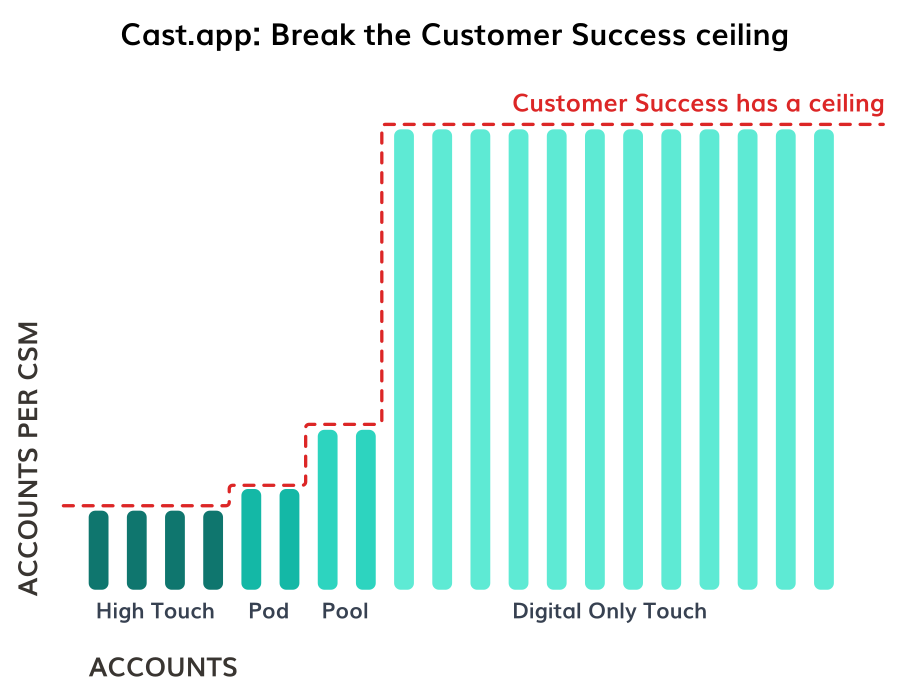
In 2025 it became Productivity AI — AI copilots bolted onto the team and called leverage. Copilots are genuinely useful — but they're solving the wrong problem. The bottleneck in customer success was never how productive each CSM is. It's how many accounts one CSM can cover at all. Until that changes, the ceiling stays exactly where it is.
~$2M of ARR per CSM, means every new tranche of accounts demands another hire.
Because the cost of coverage finally got expensive enough to notice. The familiar rule of thumb — roughly $2M in ARR managed per CSM [3] — means coverage grows in lockstep with headcount: every new tranche of accounts demands another hire.
~8% of ARR spent on customer success and support.
~10% if you lean in.
On top of that, customer success and support together run around 8% of ARR for a typical private SaaS company, per SaaS Capital [1], and closer to 10% at companies that lean into it. In the zero-interest era, nobody audited that line. In 2026, PE operators and CFOs do.
When Rule of 40 is the scorecard.
A function that costs a tenth of revenue is an obvious place to look.
When the Rule of 40 is the scorecard and growth has cooled across the category, a function that costs a tenth of revenue and scales linearly with the customer base is an obvious place to look.
$2.00 to acquire a new ARR dollar.
$0.61 to expand one.
Your coverage model rations the cheap one.
The irony is that the spend protects the cheapest revenue you have. Benchmarkit's 2025 data puts the cost of new ARR at about $2.00 of sales and marketing for every $1.00 won — versus roughly $0.61 to expand an account you already own [2]. Expansion is the best deal in software. And it's exactly the thing your coverage model rations.
No — and it's worth being precise about why. AI copilots help, genuinely. They draft the review, summarize the call, write the follow-up, and hand a CSM back a few hours a day. That's real. The rote work and grunt work shrink.
But hours saved per CSM is not accounts covered. A copilot lowers the cost of the work a CSM already does; it doesn't change how many customers that CSM can own. Give every rep an extra two hours a day and you still can't hand them twice the accounts — the relationships, the cadence, the meetings don't compress that way.
So the math underneath stays fixed: add accounts, add heads. Copilots make the existing model cheaper to run. They don't move the revenue needle, because they don't touch the ratio that caps it.
More than any org on earth will staff.
10,000 customers × 10 contacts × 100 generation steps = 10 million prompts a month. That's what covering the base actually looks like.
Picture a modest book: 10,000 customers, 10 contacts each. That's 100,000 people who'd each benefit from a personalized review of the value they're getting. Build each one properly — say 100 generation steps per presentation, across data, narrative, and Q&A — and you're at 10 million prompts. Monthly, if you want the reviews to stay current. That is what genuinely covering the base looks like as a number.
Dial it down. Even at a conservative floor — quarterly cadence, three stakeholders per account — that's 3 million generations a quarter, still an order of magnitude past what any CS team staffs against.
No customer success team is staffed against 10 million anything. So nobody tries.
Coverage gets rationed, and the long tail gets nothing. Strategic accounts get a quarterly business review. A marquee few get monthly attention. Everyone below the line — frequently most of your logos, and a meaningful slice of your expansion potential — gets zero. Not because those accounts don't matter, but because no CS org on earth would staff to cover them at a real cadence.
This is the quiet structural failure of the headcount model: the accounts most likely to deliver cheap expansion are the ones your coverage map writes off first.
And copilots don't rescue them. A copilot-assisted interaction still routes through a human's calendar. Saving each rep a few hours a day does not get you to 10 million touches. The wall is the ratio, not the speed.
The same move that fixed support: take the work directly to the customer. Self-service didn't make support reps faster — it removed the rep from the path entirely for most interactions and reserved humans for what needed them. Customer success has never had that moment. It's overdue.
The shift is to stop scaling coverage with headcount. CRMs and CS platforms work for your teams. Cast works directly for your customers and partners — presenting personalized business reviews and answering questions, direct to customers, partners, and leadership, at the full scale of the install base.
Each review is a narrated walkthrough every stakeholder can interrupt with a question and get answered on the spot. The CSM isn't replaced; they're elevated to the strategic accounts and the moments that genuinely need a human. Everyone else — including the long tail that used to get nothing — gets the marquee-account cadence, on demand.
This isn't theoretical. At Everpure (purestorage.com), personalized reviews presented direct to customers drove a 30× return and $1.6M in added annual revenue.
At HPE, C-level recipients rated the experience 9 out of 10 — the kind of executive engagement a quarterly email rarely earns.
And this isn't tokenmaxxing. Burning compute because it's cheap sells chips and AI usage — it doesn't sell sustainable coverage.
And this isn't tokenmaxxing. Burning compute because it's cheap sells chips and AI usage — it doesn't sell sustainable coverage. The discipline is matching the right amount of intelligence to what each account actually needs.
Engagement is the right question — but the bigger leak isn't the customer, it's the CSM. An AI copilot only reaches a customer if the CSM actually uses it, and copilot adoption inside CS teams typically runs 20-25%. So the customers managed by the other 75-80% of CSMs see no AI benefit at all — the tool sits idle in the seats that never opened it.
As a Digital and Scaled CS leader at NVIDIA put it to me, going direct to the customer doesn't just improve adoption — it removes the CSM gate entirely and pegs internal adoption at 100%.
Put numbers on it. Say half your customers will engage with a review once it reaches them. With copilots, the AI first has to clear CSM adoption — about 25% — so 25% × 50% leaves roughly an eighth of your base actually getting value. Go direct and the gate disappears: 100% × 50% = 50%. Same customer behavior, four times the reach.
The reviews are grounded in first-party account data — usage, outcomes, support history, contract terms — not open-ended generation. The model is pinned to what the customer actually did. For strategic accounts, a CSM can review and approve the first send — human in the loop where the stakes are highest, out of the loop where the long tail used to get nothing.
The honest comparison isn't AI versus a perfect human. It's AI grounded in account data versus a rushed CSM dropping a wrong number into a manual QBR deck on a Tuesday morning — a failure mode every CS org has lived with for years.
It decouples revenue from hiring. Expansion stops being gated by how many CSMs you can afford, because coverage scales with compute instead of headcount. The cheapest ARR in your business — the $0.61 expansion dollar — becomes capturable across the whole base, not just the top of it.
And the cost line stops climbing in lockstep with the customer count, so margin expands as you grow instead of eroding. For a PE operator, that is the rare lever that moves net revenue retention and gross margin in the same direction at the same time.
CSM-led growth has a ceiling, and AI copilots leave it intact. They make the old model a little cheaper; they don't change its shape. The model that wins is the one that covers every account — not just the ones big enough to justify a human. Don't raise the ceiling. Remove it.
Grow and scale revenue. Not headcount.
Do AI copilots replace CSMs? No. AI copilots make individual CSMs faster at the work they already do — prep, notes, follow-ups — but they don't change how many accounts one CSM can cover. They lower the cost of the existing model; they don't change its shape.
What is a good ARR-per-CSM ratio? A common rule of thumb is about $2M in ARR per CSM, with high-touch teams running closer to $1M and enterprise books stretching higher. Whatever the target, coverage still grows in lockstep with headcount — which is the structural limit, not the specific number.
How much should customer success cost as a percentage of ARR? Customer success and support together run around 8% of ARR for a typical private SaaS company, per SaaS Capital, and closer to 10% at companies that invest heavily in it. In an efficient-growth market, that linear cost is increasingly scrutinized.
How do you scale customer success without adding headcount? Take the coverage directly to the customer instead of routing every interaction through a CSM's calendar. When AI presents personalized business reviews and answers questions direct to customers, partners, and leadership, coverage scales with compute rather than headcount — so every account, including the long tail, can be covered without a proportional hire.
Dickey Singh is the founder of Cast (cast.app), where the team is building agentic CS infrastructure for enterprise customers including HPE, Pure Storage, Cloudera, and CDK Global. Cast itself runs on agentic engineering — the team uses Cursor, Claude Code, Codex, and GitHub bots daily. Cast breaks the headcount cycle: more accounts no longer means more CSMs.