The Evolution of Scaled Customer Success: From Pools, to Pods, to AI Agents.
by Dickey Singh
More Accounts = More CSMs? Break the cycle and deliver 1:1 CSM quality to 100% of stakeholders at 100% of accounts.
Digital CS and Scaled CS
The industry frequently confuses Digital Customer Success with Scaled Customer Success. That’s a fundamental misunderstanding: digital is how you deliver; scaled is how you operate.
Before defining the new model, it is critical to distinguish between "Digital Customer Success" (the tactic) and "Scaled Customer Success" (the strategy). While they depend on each other, they solve different problems for different leaders.
Feature
Digital Customer Success (The Tactic)
Scaled Customer Success (The Strategy)
The Question
"What tools and campaigns should I use?"
"How do I structure my team and budget?"
The Goal
Efficiency through automation.
Maximum Revenue per Human Headcount.
The Primary Persona
CS Ops & Digital CSMs.
VP of Success, CCO, CFO.
The Shift
From generic email → personalized AI presentations.
From Account Owners → Subject Matter Experts.
To understand the tools required, read our guide on Digital Customer Success. To understand the organizational structure, read on.
The Evolution of Scaled Customer Success
For the last decade, the standard playbook for scaling CS has been simple but flawed: segment customers by Annual Contract Value (ACV). The top 20% got a "White Glove" named CSM. The bottom 80%—the "long tail"—were ignored until renewal time.
To fix this "Coverage Gap" without bankrupting the company, CX/CS leaders iterated through three models.
Scaled CS 1.0: The Pool (Reactive Support)
The first attempt was to take the long tail and remove their dedicated CSM. Instead, they were given a shared email address (success@company.com) managed by a group of junior CSMs.
The Logic: "Low revenue customers don't deserve high-cost time."
The Reality: This wasn't Success; it was Support. It was entirely reactive. Customers felt like ticket numbers, forced to re-explain their context to a different person every time they reached out. Churn in the "tail" exploded.
Scaled CS 2.0: The Pod (The "Band-Aid")
To fix the relationship problem of the Pool, leaders invented the Pod. This typically takes one of two forms:
The Shared Book Pod: A group of 3–4 CSMs acts as a "Hive Mind" for a specific set of accounts. If your main contact is out, someone else in the pod knows you.
The Cross-Functional Team: A CSM, an Onboarding Specialist, and a Support Rep form a permanent unit dedicated to a specific set of accounts or sometimes a vertical (e.g., "The Healthcare Pod").
While this offers better continuity and mitigates the damage of human turnover, it creates a dangerous illusion for the CFO.
The Result: The "Hybrid Maze"
Most companies today are stuck in a messy combination of the two: "Segment A gets Named, Segment B gets a Pod, Segment C gets the Pool." This creates an operational nightmare of inconsistent customer experiences and constant internal friction.
Scaled CS 3.0: The AI Agent (Infinite Capacity)
True Scaled Customer Success requires a paradigm shift. You must stop segmenting customers based on how much they pay you, and start segmenting based on what they need right now.
Instead of grouping humans to cover the gap, you deploy AI Agents to close it.
The AI-First Organization
In the 3.0 model:
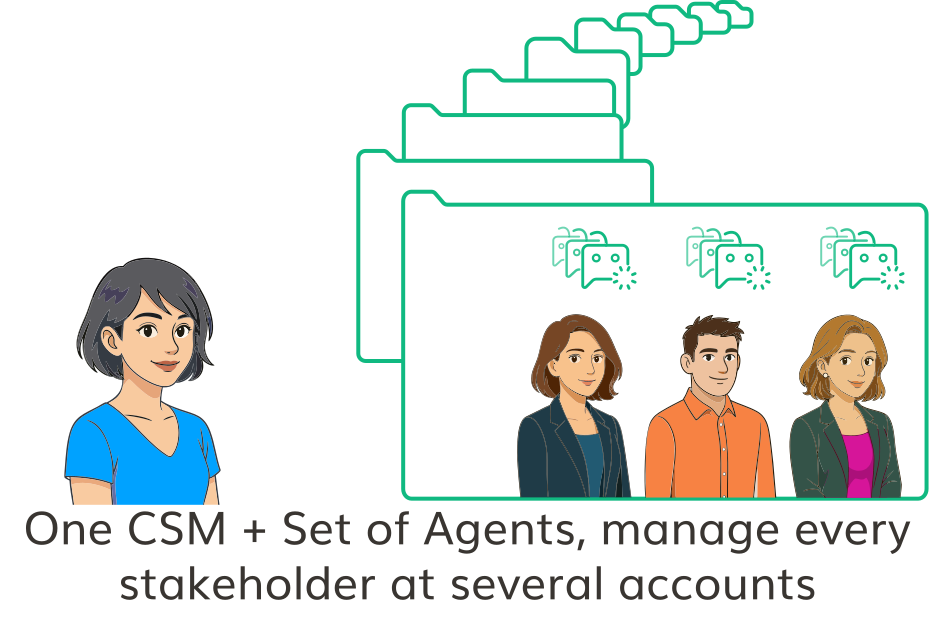
100% of Customers receive a dedicated "Named CSM"—it just happens to be an AI Agent. This agent handles the relationship, the strategy, and the day-to-day progress.
Human CSMs stop being "Account Owners" for a chosen few and become high-level Subject Matter Experts (SMEs) available to everyone.
The New Organizational Chart
The AI handles the "Operational Lifecycle." The humans handle the "Strategic Exceptions."
When a customer has a complex issue, a high-stakes negotiation, or an intricate technical challenge, the AI Agent loops in the human SME. The human parachutes in, solves the complex problem with full context provided by the AI, and then hands the reins back to the AI Agent.
You no longer hire for "coverage." You hire for expertise.
The Evidence: Traditional Models vs. AI-Scaled Model
Compared to the legacy attempts at scaling, the AI-First model is superior in every metric that matters to leadership.