
By Dickey Singh, CEO and Founder, Cast.app
I spent the weekend watching the core sessions from Davos 2026. While the mainstream headlines focused on safety timelines from Demis Hassabis, CEO of Google DeepMind, and Dario Amodei, CEO of Anthropic, or the macroeconomic warnings from Jamie Dimon at JPMorgan, my takeaway was different.
Most people are still looking at AI as a software cycle. They compare it to the dot-com boom or the mobile app revolution.
They are wrong.
After listening to Nvidia CEO Jensen Huang describe the state of the industry to BlackRock’s Larry Fink, it became clear that we are not just watching a software upgrade. We are watching a fundamental reset in the cost of doing work.
The trillions being spent on infrastructure today are designed to drive the marginal cost of intelligence toward zero. For businesses, this means problems that were previously too expensive to solve—like 1:1 customer onboarding or real-time medical charting—are suddenly profitable.
Jensen described the economy not as a vague "cloud" of algorithms, but as a physical, heavy-industry stack he calls the "5-Layer AI Cake." Understanding this stack is the only way to understand where capital is going, where the bottlenecks are, and most importantly, where the actual value will be generated in 2026.
Here is the blueprint for the new economy.
When Jensen looks at AI, he does not see code. He sees manufacturing. Just as we built factories to manufacture cars in the 20th century, we are now building factories to manufacture "tokens of intelligence."
This manufacturing process requires a vertical stack of five distinct layers.
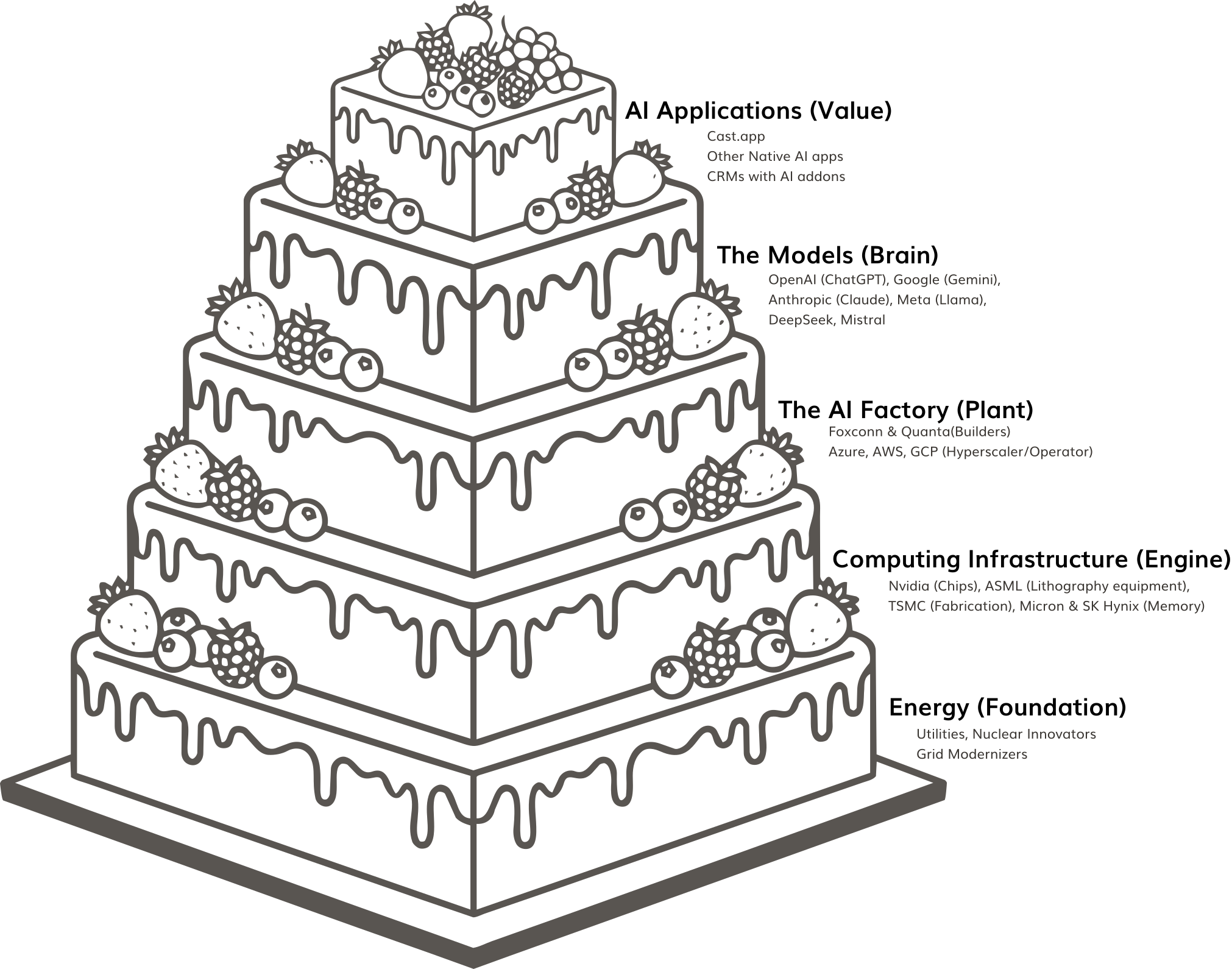
This is the bottleneck. You cannot manufacture intelligence without massive, stable, baseload power. Jensen was explicit that the energy sector is now effectively part of the tech stack. This layer belongs to the utilities, the nuclear innovators, and the grid modernizers. Without electrons, there is no intelligence.
This is the physical machinery that processes the data. It is where Nvidia lives, but they do not live there alone. This layer relies on a complex, physical supply chain involving ASML for the lithography equipment, TSMC for fabrication, and memory giants like Micron and SK Hynix. It is heavy hardware, not software.
Data centers are no longer just "storage lockers" for our photos. They are production plants. This layer includes the builders like Foxconn and Quanta who construct the physical shells, and the hyperscalers like Azure, AWS, and GCP who operate them.
This is the layer that has captured the public’s imagination for the last three years. It is the domain of OpenAI, Google (Gemini), and Anthropic (Claude). But it is not a monopoly. Players like Meta (Llama), DeepSeek, and Mistral are proving that high-level intelligence is becoming abundant and accessible. While critical, Jensen views this layer merely as the "raw intelligence" that must be distributed, not the end product itself.
This is the top of the stack. It is the layer where the intelligence is actually applied to solve a specific business problem. And according to Jensen, 2026 is the year the economy finally pivots to this layer.
This pivot isn't about legacy giants like Salesforce simply adding a "chatbot" button to 20-year-old software. It is about a new class of AI-Native Applications built from the ground up to solve problems that were previously too expensive to touch.
In the old economy, scaling Customer Success meant hiring more humans to manually onboard clients and answer support tickets. That is the "factory work" of SaaS.
Cast.app sits squarely at Layer 5, using the underlying intelligence to automate that friction entirely. It handles onboarding, support deflection, and expansion loops on autopilot.
Cast.app doesn't just save money; it changes the unit economics of the business, allowing teams to focus on strategy while the software handles the scale.
The reason this framework matters is that it reveals the maturity curve of the industry.
Think of the global economy like a massive startup.
For the last three years, trillions of dollars in capital expenditure (CapEx) have been poured into the bottom four layers. We have been pouring concrete, retrofitting power grids, fabricating GPUs, and training foundation models. This is all cost. It is infrastructure.
This is where the product (intelligence) finally reaches the customer.
Until now, we have been obsessed with the factory. We marvel at the size of the data centers and the speed of the chips. But a factory that produces inventory nobody uses is a failure. 2026 marks the shift from building the capability to distributing the value.
The winners of the next cycle will not be the ones who build the best chips (Layer 2) or the smartest models (Layer 4). The winners will be the companies in Layer 5 that figure out how to weave that intelligence into the messy, complex reality of daily work.
Stop worrying about the "Lump of Labor" fallacy. The idea that there is a fixed amount of work to be done—and that AI will steal it—is wrong.
Jensen Huang dismantled this fear at Davos with a simple reality check: The economy works by multiplication, not subtraction.
When you lower the cost of intelligence, you don't just do the same work cheaper. You do more work. You solve problems you previously couldn't afford to touch.
Jensen described a 'virtuous cycle of productivity.' His argument is that
We are not heading into a job shortage. We are heading into an Ambition Surplus. When companies become highly profitable, they don't pocket the savings and shrink. They use that capital to invade new territories, launch new products, and hire people to build them.
If 2026 is the year of Layer 5, how do you capitalize on it?
You must distinguish between "Legacy Incumbents" and "AI-Native Apps." Legacy giants like Salesforce or Adobe are sprinkling AI into their existing products as features. This is useful, but it is incremental.
The real transformation comes from AI-Native Applications—platforms built from the ground up on the 5-Layer stack to solve problems that were previously unsolvable.
This is exactly where Cast.app sits.
In the old world, Customer Success was a high-friction, human-intensive effort. CS Managers spent their days fighting fires, manually onboarding clients, and chasing renewals. It was unscalable.
Cast.app uses the AI stack to automate that friction. It handles the "factory work" of customer success—automated onboarding, expansion loops, support deflection, and feedback collection.
This aligns perfectly with the logic of this Productivity Loop:
It does not replace the Customer Success team. It liberates them from being support tickets agents and elevates them to strategic partners.
The "5-Layer Cake" is more than just a tech stack. It is an economic roadmap.
We have spent the last few years obsessing over the ingredients (Energy, Chips, Models). Now, the focus shifts to the meal itself (Applications).
The only certainty is that jobs will change. The shift will be faster than the move from farms to factories. But for leaders who understand the Ambition Surplus, this is not a threat. It is the greatest opportunity for expansion we have ever seen.
The question is not "Will AI replace us?" The question is: "How are you training your teams to use this infrastructure to build something bigger than you could yesterday?"