By Dickey Singh, CEO and Founder, Cast.app
Too many companies still think this way:
That sounds right inside the company.
It often does not feel right to the customer.
Most customers do not want more people in the middle. They want faster answers. Faster follow-through. Faster decisions. Less waiting. Fewer handoffs. Clearer guidance. More control. More consistency.
That is the shift.
This is not about caring less. It is not about removing humans from important moments. It is about breaking the habit of solving every customer problem with more people.
A lot of businesses still deliver customer experience through labor.
The next generation delivers it through leverage.
A headcount mindset treats customer experience as a staffing problem.
More customers? Add more people.
More complexity? Add more specialists.
More tools? Add more operators in the middle.
More gaps? Add more meetings.
It works for a while. Then the cost shows up.
Costs go up. Speed goes down. Quality gets uneven. Customers depend on specific people. Internal teams spend more time coordinating than improving the experience.
What looks like care from the inside can feel like friction from the outside.
This is the hidden cost of headcount-heavy customer operations. The company keeps hiring to patch gaps instead of fixing the system that created them.
When every customer problem is solved with people, growth gets expensive, slow, and brittle.
Paul Graham was right.
Early on, founders should do things that do not scale.
That is how you learn. That is how you hear customer pain directly. That is how you find product-market fit. That is how you build the first real motion.
The problem is not doing manual work early.
The problem is never leaving that mode.
Some businesses stay in pre-scale behavior long after they should have evolved.
More customers? Add more teams.
More teams? Add more tools for them.
More tools? Add more handoffs.
More handoffs? Add more managers to manage the handoffs.
What started as a smart early tactic becomes the business model.
That is where companies get stuck.
They call it high-touch. They call it premium. They call it customer-centric.
Often, it just means they never productized their own success.
“Do things that don’t scale” is a discovery strategy. It is not a forever operating model.
Humans are great at finding the motion.
They build trust. They notice patterns. They handle nuance. They ask better questions. They calm down tense moments. They help customers make important decisions with confidence.
That part matters. It will keep mattering.
But once the motion is clear, people should not stay the main delivery layer for every repeated interaction.
That is where leverage comes in.
People discover the motion. Systems scale the motion.
In a leverage mindset, people build the machine. They are not the machine.
Humans should design and improve the system, not manually perform every recurring interaction.
That is not anti-human.
It is pro-human where humans matter most.
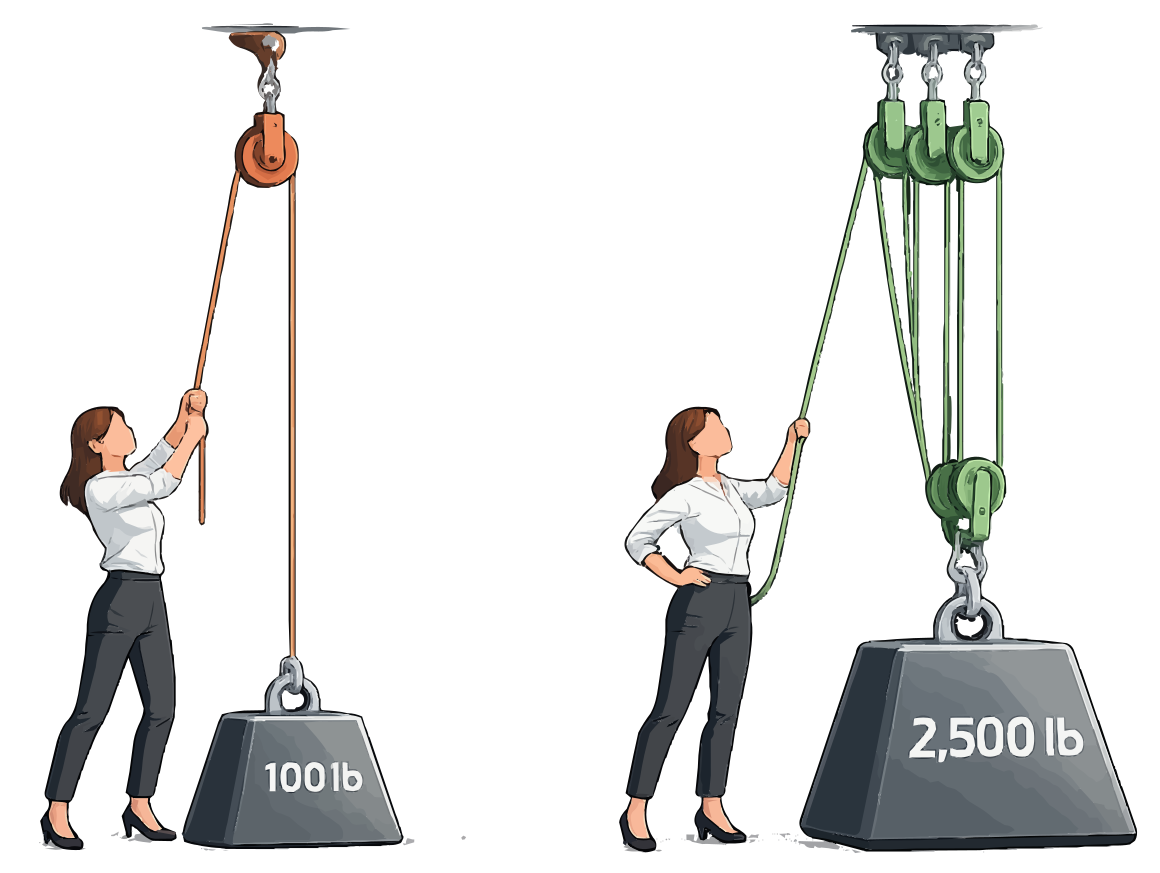
A scale mindset is really a leverage mindset.
Here is the simple difference:
Growth is linear.
Input = Output
Add more people, get more output.
Add more budget, get more coverage.
Add more managers, get more coordination.
That is growth.
Scale is leverage.
Input < Output
The output grows faster than the input.
That happens when a company gets better at using product, automation, AI, community, process, and system design to deliver better outcomes without adding headcount in lockstep.
A leverage mindset asks a different question.
Not: Who do we hire next to handle this?
But: How do we make this work better without needing a person every time?
That does not mean removing humans from important work.
It means removing unnecessary human dependency from repeated work.
A leverage mindset turns what works into a system instead of keeping it trapped inside people.
Are we confusing high-touch with high-labor?
This may be one of the biggest mistakes in customer experience.
A lot of companies assume that if more people are involved, the customer must be getting a better experience. But customers rarely wake up hoping for more meetings, more emails, more status calls, more handoffs, or more waiting.
They want the opposite.
They want speed. Clarity. Confidence. Control. Consistency. Progress.
That is why high-touch and high-labor are not the same thing.
High-touch is about how supported the customer feels. High-labor is about how much manual effort the company needs behind the scenes to create that feeling.
Those are very different things.
A customer can feel highly supported through proactive guidance, personalized reviews, fast answers, always-on help, smart follow-through, clear next steps, and quick escalation when needed. None of that requires a person to manually push every step every time.
Premium experience is not more labor around the customer. It is the right people in the right moments, with systems and agents removing the rest of the friction.
Labor is about the effort you expend. Love is about the outcome the customer achieves. Don’t ask customers to appreciate your labor. Ask whether they love their results.
High-touch should be an experience standard. High-labor is just an operating model.
Too many businesses still hide behind “high touch” when what they really mean is that their product and process still need too many people.
That is why high-touch is becoming the new excuse for not scaling.
And if you are not building for leverage, a competitor likely already is.
One of the most common lines in customer-facing businesses is this:
“Our customers want a dedicated person.”
Sometimes they do.
For strategic accounts, complex situations, sensitive moments, and big decisions, human relationships matter a lot.
But that is not the full story.
Most customers do not want a dedicated person for its own sake.
They want:
A dedicated person is sometimes the right service model.
Too often, it is just a patch.
A patch for a product that still has friction.
A patch for a process that still has gaps.
A patch for a tool stack that still does not work well together.
Real customer centricity is self-success.
It is helping the customer move faster, with more confidence, and with less dependency on recurring hand-holding.
It is teaching the customer to fish, not selling them a fish every Tuesday on Zoom.
The best companies are not less customer-centric.
They are more customer-centric with less dependence on linear headcount growth.
The future is not human-free.
It is less dependent on humans for every repeated interaction.
That is a much better goal.
Use humans for:
Use systems, automation, and agents for:
That is customer centricity with operating leverage.
It does not lower the bar.
It raises the bar.
Because now the company can deliver a strong experience to more customers, more often, with more consistency.
Not just the top accounts. Not just the loudest accounts. Not just the accounts lucky enough to get the best rep.
That is what customer centricity looks like when it grows up.
There is a bigger shift happening underneath all of this.
Efficient operations companies are coming for the headcount-heavy incumbents.
They are looking at old service models and asking simple questions:
For years, many businesses hired people to bridge product gaps, process gaps, and coordination gaps.
That worked until more efficient operators started redesigning the experience itself.
The next winners will not just hire better.
They will operate better.
They will reduce friction.
They will remove middle layers.
They will turn repeated work into systems.
They will make customer outcomes easier to access.
Stop hiring for the gap. Start building for the scale.
Do not be the company that gets replaced by a competitor that turns your “dedicated person” into a faster, smoother, more consistent experience.
Every labor-heavy workflow is a startup idea for someone with a leverage mindset.
This is where Cast fits.
Cast helps companies move from people-dependent customer operations to system-enabled customer experience.
That means shifting away from:
And shifting toward:
Cast brings a scale mindset — a leverage mindset — to customer-facing work.
Not by removing humans from the moments that matter.
By removing unnecessary human dependency from the moments that repeat.
That is the point.
The future is not more people in the middle.
The future is better systems around the customer, with the right humans stepping in where they add the most value.
That is how companies grow revenue and improve customer experience without growing headcount in lockstep.
That is leverage.
That is scale.
That is where customer-centric companies are going next.