By Dickey Singh, CEO and Founder, Cast.app
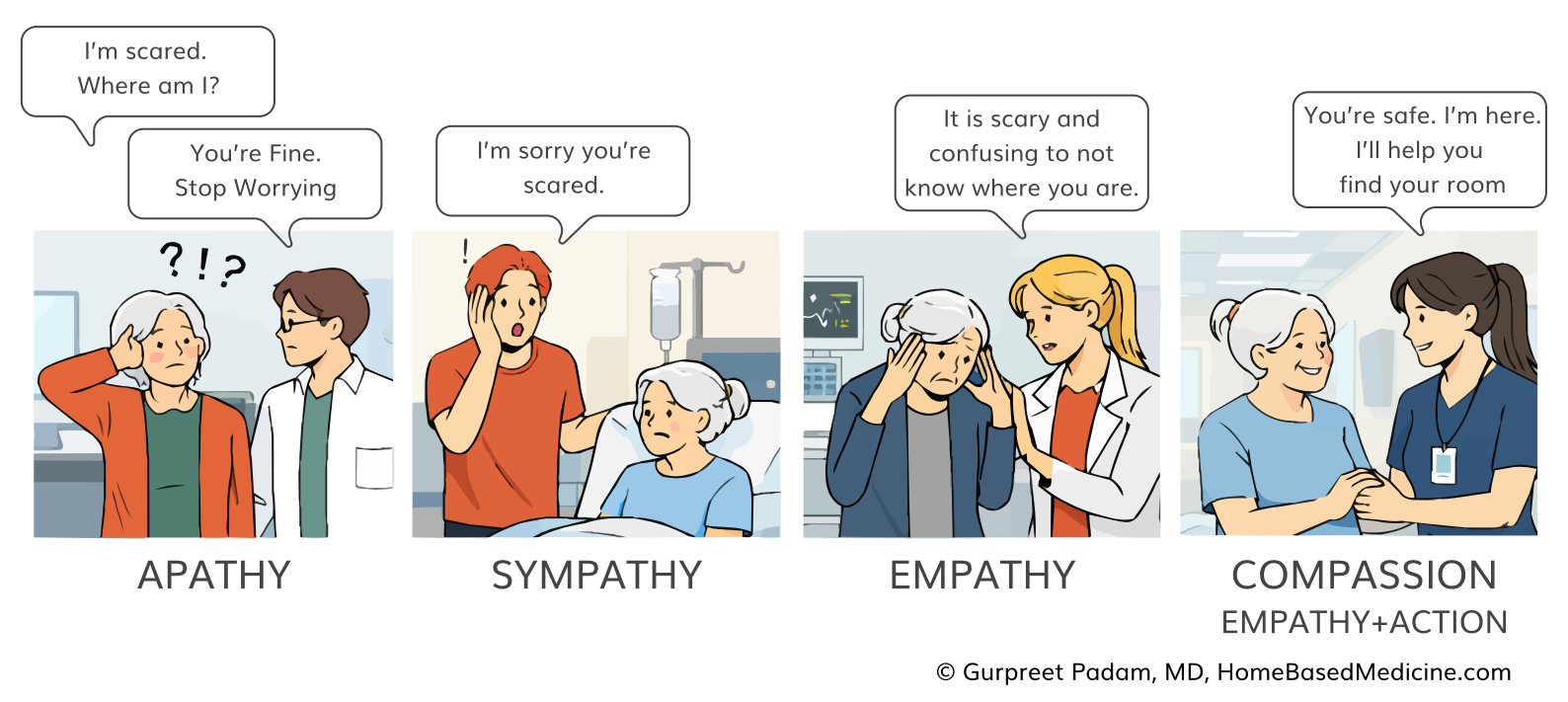
Last week at a Stanford dinner, I listened to Gurpreet K. Padam, MD, FAAFP walk through a simple spectrum from apathy to compassion, in the context of healthcare.
Her point was blunt: feeling isn’t care. Care is action1
On the drive home, I realized we have the exact same gap in B2B. Customers don’t churn because they feel misunderstood; they churn because getting back on track arrives too late.
Have we turned empathy into a replacement for resolution?
When did empathy become the SLA?
This essay applies Stanford University’s compassion inaction model to the entire B2B customer journey: support, success, renewals, and expansion.
In B2B, we treat "Empathy" as the ultimate virtue. We hire for it, train for it, and measure it. We teach sales people to echo the prospect's challenges. We teach our CSMs and Support Agents to listen actively, validate frustration, and say, "I understand how hard this is for you."
In B2B, empathy without resolution isn't customer success.
It’s lip service.
Stanford University’s Center for Compassion and Altruism Research and Education (CCARE) draws a distinction the business world tends to blur:
In medicine, “I understand” without treatment isn’t care. In B2B, “I understand” without unblocking the path to outcomes is just sympathy in a nicer tone.
In B2B, a vendor who empathizes with a client's frustration but lacks the means to fix the problem is simply a sympathetic bystander.
For a deeper dive into this distinction, I highly recommend exploring Stanford University’s Applied Compassion Training and their Capstone Projects.
To move from "Lip Service" to results, we must map how our teams react to customer pain. Are we just feeling it, or are we fixing it?
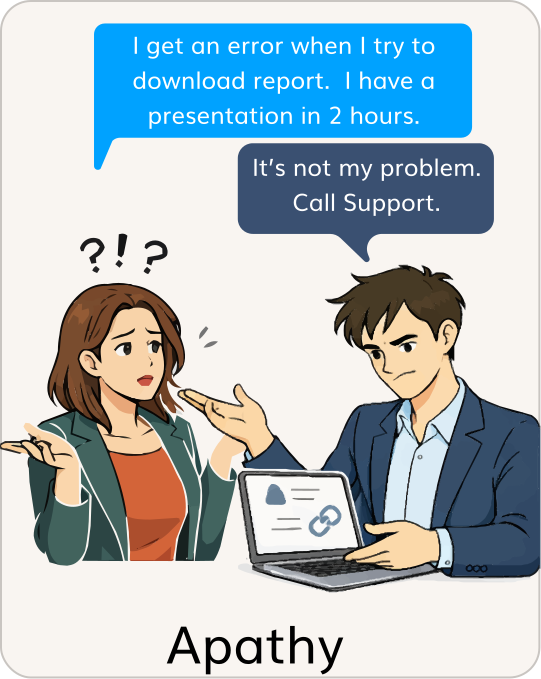
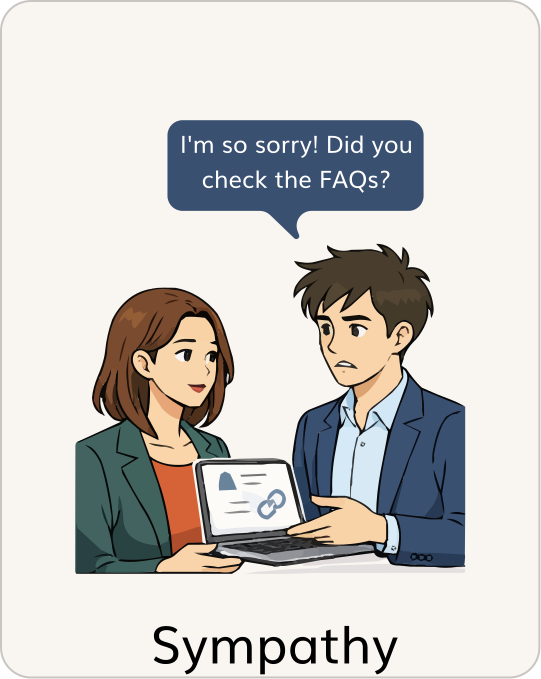
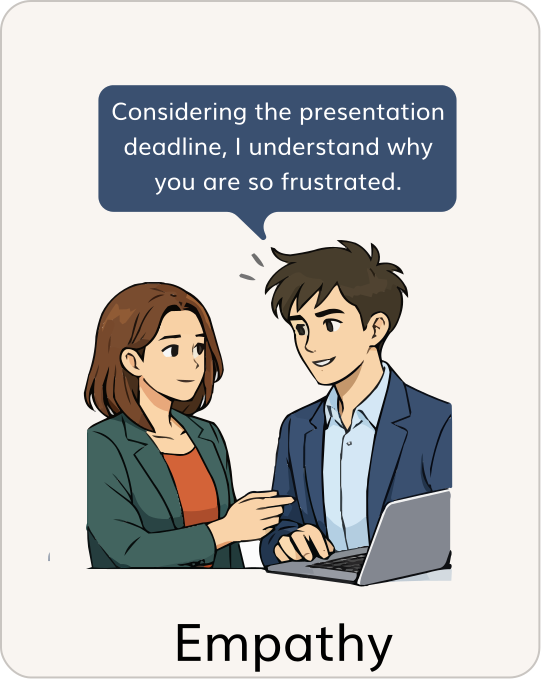
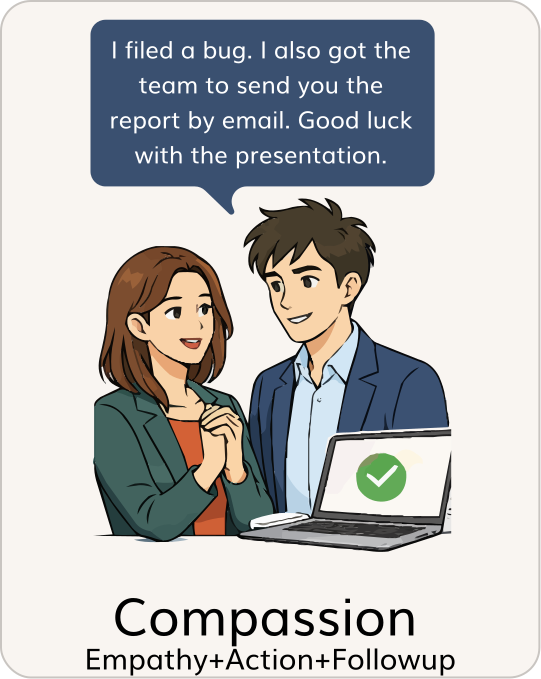
This is also the cleanest way to understand the shift from old chatbots to agentic technology.
The Old Way (chatbots): conversational empathy. They can acknowledge frustration, summarize docs, and point to the right link—then the customer (or a human) still has to do the work. Empathy becomes a polite wrapper around delay.
The New Way (agentic systems): operational compassion. The system doesn’t just respond—it can drive the next step, coordinate across systems, and reduce customer effort until the customer is back to outcomes. That’s what it means to digitize action: understanding paired with execution.
Disclaimer: agentic systems aren’t automatically better—without guardrails, they can do the wrong thing faster.
That’s why Cast agents are built around scoped authority + competence + follow-through—not to “sound empathetic,” but to reliably move customers back to outcomes:
Goals are being met.
Looking at that spectrum, it is easy to blame individual CSMs for getting stuck at "Empathy." But the root cause isn't a lack of caring; it is a math problem.
Your team stays in the "Lip Service" zone because the unit economics of human labor don't allow them to cross into Co-ownership for every account.
When we talk about the "Entire Customer Journey," we aren't just talking about Support tickets. We are talking about the 5S Ecosystem:
In the human-only model, Support demand crowds out Sales and Sentiment. Compassion fails—not from intent, but from bandwidth.
If the barrier to compassion is the "Capacity Wall,"—the impossibility of assigning a human to every account, then the solution isn't more humans.
The solution is to digitize the action.
This is where Cast agents transform the journey. By digitizing the competence + scoped authority required to solve problems, compassion becomes scalable.
Here is how we move from the Old Way to the New Way:
Dr. Padam’s lesson for healthcare applies perfectly to B2B: Compassion is empathy that moves.
Your customers don't just want to be heard; they want to be unblocked. By using technology to handle the heavy lifting across the 5S ecosystem, you are giving your customers the most compassionate gift of all: a frictionless path to success.
Is empathy enough in B2B Customer Success?
No. Empathy builds trust, but it doesn’t restore momentum. In B2B, empathy without resolution turns into delay—and delay becomes churn risk.
What does Stanford University mean by “compassion” in this model?
Compassion is empathy plus action. It’s the move from understanding someone’s pain to actively reducing it.
What does “compassion” look like in B2B—without turning into white glove?
It looks like removing customer effort. Drive the next action, coordinate across systems, escalate when needed, and verify outcomes—without making the customer manage the process.
How is this different from traditional chatbots?
Traditional chatbots are mostly conversational: they answer, apologize, and link to content. Agentic systems can execute: they take safe steps, route work, and close the loop until the customer is back on track.
What causes “empathy as lip service” in the first place?
It’s usually capacity math, not bad intent. When one human can’t cover every account, empathy becomes the only scalable behavior—unless you digitize the action.
How do you scale compassion across the long tail of accounts?
You digitize the competence and scoped authority needed to resolve common issues and drive next steps. Humans focus on judgment calls; the system handles repeatable action and follow-up.
What should leadership measure to know compassion is working?
Measure time-to-outcome, not time-to-response: time-to-value, time-to-recovery after a drop in health, and how often customers get back to “on track” without chasing.
———————
1: Credit
Gurpreet K. Padam MD, FAAFP, HomeBasedMedicine.com
Family, Palliative, and Lifestyle Medicine
Diplomate: American Board of Family Medicine
Diplomate: American Board of Lifestyle Medicine
Stanford University/VA: Hospice & Palliative Medicine Fellowship
Stanford University School of Medicine: GREC: Ethnogeriatrics
Stanford University School of Medicine-CCARE: Ambassador of Applied Compassion