By Dickey Singh, CEO and Founder, Cast.app
Feb 2026 Note: AMA 2.0 (Ask Me Anything) is now in limited rollout with select customers.
March 2026 Update: AMA 2.0 (Ask Me Anything) is now Generally Available to everyone.
We’ve spent the last few quarters engineering the next phase of the customer relationship. AMA 2.0 moved through its initial rollout phase last month to full GA, and it represents a major step forward in how enterprise B2B organizations answer questions, maintain momentum, and orchestrate post-sales execution.
When we launched Cast AMA two years ago, it was state-of-the-art for large B2B organizations. It performed well in real enterprise environments. AMA 2.0 is the next major step forward—built for broader business context, stronger orchestration, and enterprise-grade performance.
AMA is Cast’s enterprise Ask Me Anything layer for everything post-sales.
Customers do not do business with isolated internal departments like Support, Success, Services, Voice of Customer, or Account Management. They do business with your company.
AMA is built for that standard.
Instead of limiting answers to static FAQs and knowledge bases, AMA is designed to answer across the full business context behind modern B2B customer relationships—so conversations can keep moving with the context people actually need.
See what changed in the latest release in AMA 2.0: The 68% Problem in B2B Customer Conversations.
With Cast AMA, you can embed a secure, intelligent Q&A interface directly into your product or deliver it through channels your users already use, including email.
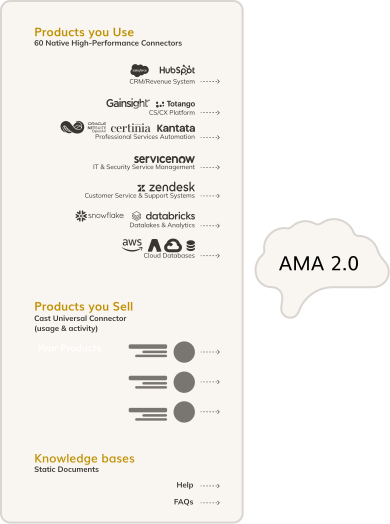
AMA connects to the systems behind your post-sales workflows—CRM, usage data, support documentation, success plans, and more—to answer account-specific questions in real time.
Examples of what users ask:
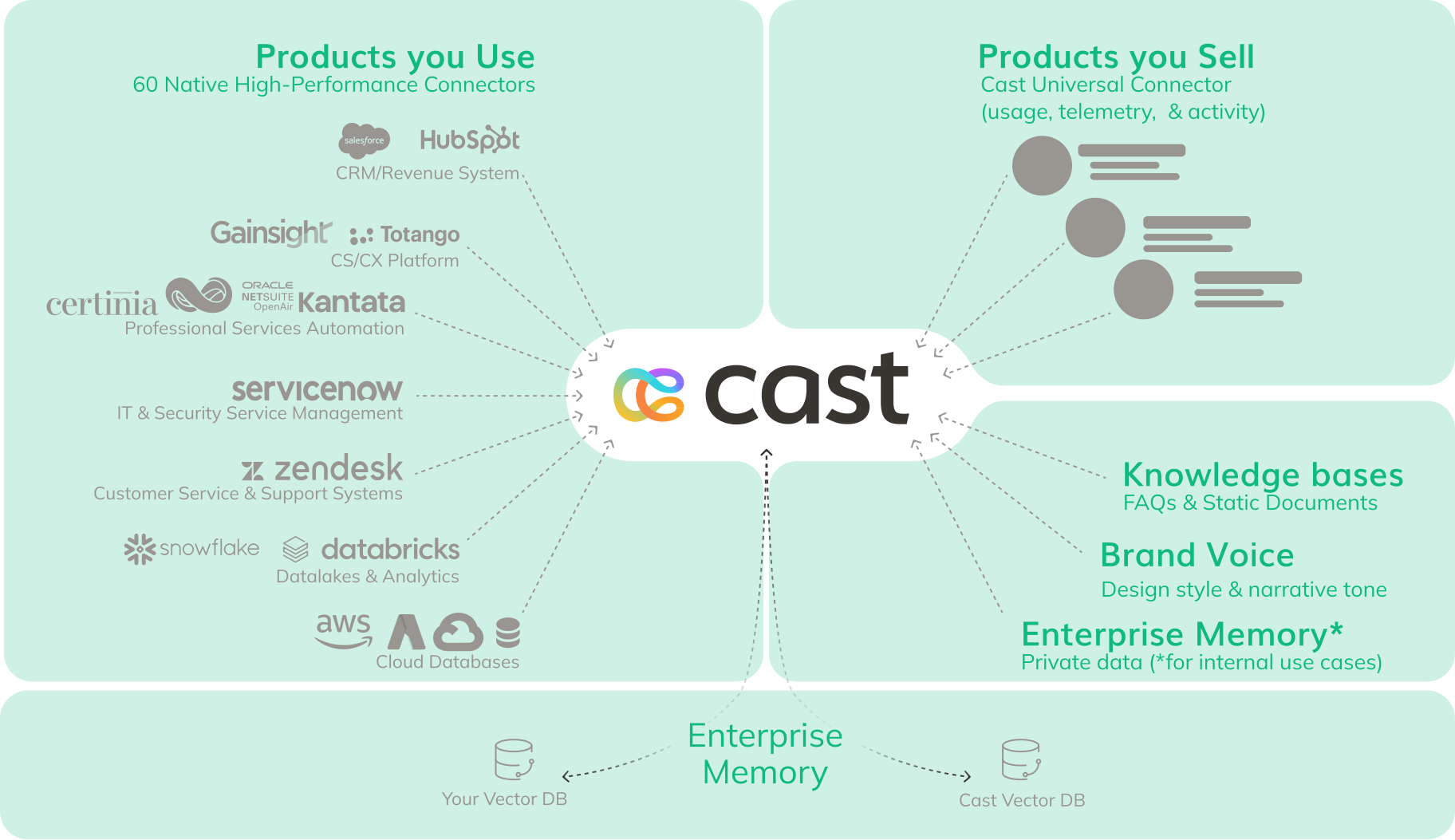
AMA is designed to operate across the systems and context layers enterprise teams actually use—and the products you sell.
AMA connects across the full post-sales business context—products you use, products you sell, knowledge bases, brand voice, and governed enterprise memory.
This gives AMA broad coverage across customer-facing use cases, partner use cases, internal stakeholder workflows, and partner-branded indirect customer experiences.
In other words, AMA is not just a support chatbot. It is an enterprise post-sales interaction layer.
AMA 2.0 expands this foundation with stronger orchestration, voice + visuals, and built/bought agent interoperability. Read what’s new in AMA 2.0.
In live Business Reviews and customer conversations, users interrupt. They do not sit back and ask generic questions.
They ask deep, specific questions such as:
Most AI experiences today answer from static knowledge bases and FAQs. That can help—but only to a point, especially given the lag and effort required to keep static documentation current. It also does not reflect how enterprise post-sales conversations actually work.
Many chatbots are excellent at recycling FAQs and sharing links, but they usually lack account context, stakeholder context, and live business data. When faced with a specific question about a contract, usage trend, or benchmark, they often stall and force the customer to wait for a human follow-up.
AMA is different. It connects static knowledge with live customer context across the systems your team already uses. Because it can operate with account-specific context—contract details, usage history, milestones, goals, and more—it can do more than recite policy. It can explain trends, calculate value, and answer questions in context.
AMA is not just a support bot. It is an always-on post-sales interaction layer that supports onboarding, customer success, account management, renewals, and stakeholder communication through a single interface.
So what can you ask?
Anything.
AMA is built for live, real-world conversations where users ask questions in the middle of a presentation, review, or walkthrough.
Watch how the Cast Agent can deliver a data-driven presentation and then handle a live interruption—seamlessly switching from Presenter Mode (full audio) to Q&A Mode (interactive) the moment a customer asks a question.
That shift gives the user control of the conversation while preserving momentum.
For the latest product updates before you watch, read what’s new in AMA 2.0.
In B2B customer conversations, momentum matters.
One of the biggest hidden costs in post-sales workflows is the delay between a question and a useful answer. AMA is designed to reduce that delay by continuing the conversation across the full business context—not just a static FAQ.
These findings are grounded in Cast’s deeper analysis of more than 800 Zoom, Gong, and Chorus recordings (2.21M minutes) of customer-facing team conversations. In that analysis, Cast reports that CSMs responded at least once with “let me get back to you” in 68% of meetings, which slowed decisions and reduced momentum.
For the full context and metrics, read the AMA 2.0 article on the 68% problem.
Different users prefer different interfaces. Some want to type. Some want to speak. Some need visual context while they ask follow-up questions.
AMA supports an intermix of interfaces so the same system can serve executives, operators, and customer-facing teams without fragmenting the experience.
AMA 2.0 adds stronger voice + visuals experiences in the latest rollout.
The agentic future is not build-or-buy. It is a strategic combination of bought and built AI agents—as long as they can talk to each other.
Most enterprise teams will operate a mixed environment:
AMA is built for that reality.
The Lifecycle Agent behind AMA, working with the Presentation Agent, acts as an orchestrator—connecting your internal built agents with bought agents and Cast agents (including the Cast Feedback Agent) so your team can focus its build cycles on what is most proprietary.
The goal is not to force a single-agent architecture. The goal is to make the ecosystem work together.
Read more in the AMA 2.0 article section on Build vs. Buy.
AMA runs on Cast’s AI infrastructure to support enterprise-grade performance, reliability, and precision in tool-calling—especially in environments where answers require coordination across multiple systems, not just retrieval from a single source.
With stronger grounding in enterprise data and system-level context, AMA is designed to improve answer quality while supporting governance requirements and complex operating models.
AMA is designed to combine:
This helps reduce hallucinations while preserving the responsiveness users expect in live conversations.
Read the AMA 2.0 architecture overview for the latest rollout details.
AMA is built for enterprise B2B organizations operating in complex post-sales environments.
If your organization serves customers across multiple systems, teams, and channels, AMA is built for that operating model.
AMA continues to evolve. AMA 2.0 adds stronger orchestration, enhanced voice + visuals, improved tool-calling precision, and deeper support for built-and-bought agent interoperability—while expanding through a phased rollout.
Read the AMA 2.0 update.
AMA is Cast’s enterprise Ask Me Anything layer for everything post-sales. It is designed to help customers, partners, and internal stakeholders get fast, account-specific answers across knowledge bases, enterprise systems, product telemetry, and governed enterprise memory.
AMA is built for enterprise B2B organizations with complex post-sales environments, including support, customer success, services, voice of customer, account management, leadership, and partner teams.
No. AMA is built for everything post-sales, not just support. It can support customer-facing, partner-facing, and internal stakeholder workflows across multiple teams and systems.
AMA can answer across knowledge bases and FAQs, systems your company uses (CRM, CS/CX, ticketing, analytics, cloud/data), products your company sells (usage, telemetry, activity, product signals), enterprise memory, and brand voice/narrative context.
Yes. AMA supports chat, voice, and visuals so different users can interact in the way that works best for them.
No. AMA can support your vector DB or Cast Vector DB depending on your architecture and governance requirements.
Yes. AMA is designed for a world of both bought and built AI agents. The Lifecycle Agent behind AMA can orchestrate with your internal agents and with Cast agents, including the Cast Feedback Agent.
Most AI support chat tools primarily answer from static FAQs and knowledge bases. AMA is designed to answer across a broader enterprise business context, including systems you use, products you sell, enterprise memory, brand voice, and orchestrated agent workflows.